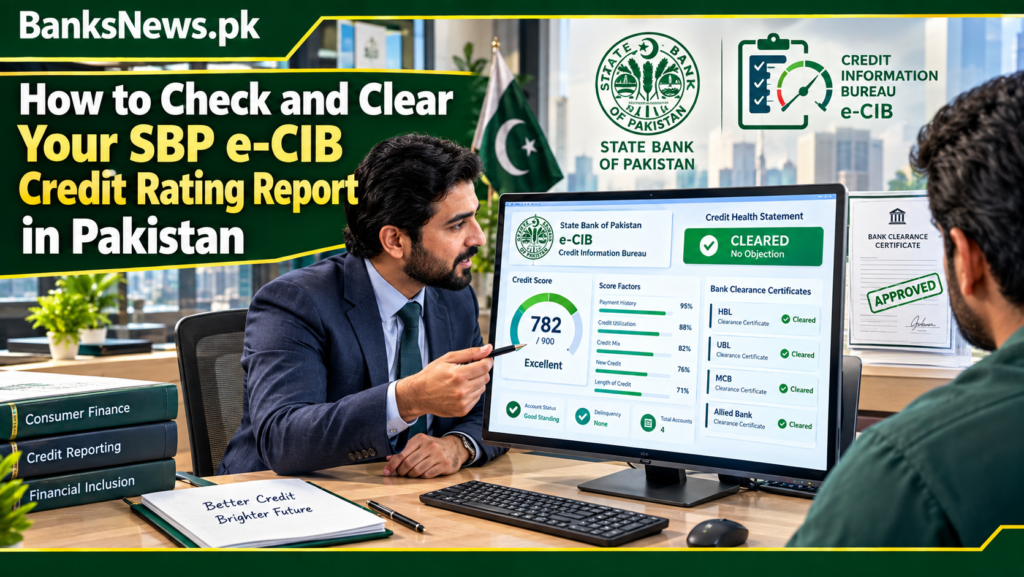
Whenever you apply for a credit card, auto lease, personal loan, home mortgage, or commercial working capital line in Pakistan, the lending institution’s credit risk department performs an initial check against the State Bank of Pakistan’s Electronic Credit Information Bureau (e-CIB).
A single unpaid nano-loan, a forgotten annual credit card fee, or a disputed phone installment can trigger an overdue flag, leading to immediate loan rejections across all scheduled commercial banks, microfinance institutions, and digital lenders.
Below is a detailed guide on how the e-CIB database operates, how individual consumers can pull their own credit reports legally, how overdue classifications are structured, and the exact process to clear negative marks and obtain a clean credit rating.
What Is the SBP e-CIB and Who Feeds It?
Established by the State Bank of Pakistan under the Banking Companies Ordinance, 1962, the e-CIB is a centralized database that tracks the credit behavior of every consumer and business borrower in the country.
- Mandatory Data Uploads: Every licensed scheduled bank, Islamic bank, microfinance bank, Non-Banking Finance Company (NBFC), and developmental finance institution (DFI) is legally mandated to upload month-end customer repayment logs directly to the e-CIB system by the 10th of each calendar month.
- Scope of Reported Credit: The bureau records credit cards, personal loans, auto finance, home mortgages, running overdraft lines, bank guarantees, corporate facilities, and digital wallet nano-loans (e.g., JazzCash ReadyCash, Easypaisa Easycash).
- The 24-to-36-Month Lookback Window: Under standard SBP guidelines, a regular consumer credit report displays your monthly repayment track record across the preceding 24 months (2 years), while major corporate or severe defaults remain visible on historical audits for up to 5 years.
How Individual Consumers Can Check Their Credit Report
Direct, retail access to the SBP’s internal e-CIB system is restricted primarily to authorized lending institutions. However, under the Credit Bureau Act, 2015, the State Bank licensed private credit bureaus to provide individuals with direct, on-demand access to their credit scores and reports:
| Bureau Service | Operating Entity | Access Method | Typical Charges |
| Tasdeeq | Tasdeeq Information Services Ltd (Licensed by SBP) | Mobile App (Android/iOS) or Web Portal (tasdeeq.com) | ~PKR 350 to PKR 1,000 per report |
| Equifax Pakistan | Equifax Pakistan Credit Information Bureau | Corporate and Consumer online verification portal | ~PKR 500 to PKR 1,000 per report |
| Commercial Bank Inquiries | Any SBP-regulated commercial bank (upon loan application) | Internal bank generation during formal credit underwriting | Free or bundled into loan processing fee |
Steps to Pull Your Personal Credit Score Online
- Download the Tasdeeq or Equifax Pakistan application from the Google Play Store or Apple App Store.
- Register an account using your NADRA-verified 13-digit CNIC and mobile number registered in your own name.
- Complete digital biometric or CNIC front/back image verification.
- Pay the statutory credit verification fee via 1Link, Raast, credit card, or mobile wallet.
- Download your comprehensive Consumer Credit Information Report (CIR) in PDF format, displaying your overall credit score (ranging from 300 to 900) and a comprehensive breakdown of all active, settled, and overdue accounts.
Anatomy of Overdue Status Codes on an e-CIB Statement
Credit bureaus track the exact number of days a payment is delayed using standardized delinquency buckets:
[0 to 29 Days: Current / Normal] ──> No adverse impact on credit score
                 │
                 ▼
[30 to 59 Days: Watchlist / Overdue] ──> Automatic warning flag on risk systems
                 │
                 ▼
[60 to 89 Days: Substandard] ──> Credit card lines restricted; new loans halted
                 │
                 ▼
[90 to 179 Days: Doubtful] ──> Significant credit downgrade across all banks
                 │
                 ▼
[180+ Days / Write-Off: Loss] ──> Classified default; legal recovery initiated
- Current / 0–29 Days: Payments made on time or within the customary grace period. Your profile reflects clean creditworthiness.
- 30 to 59 Days Overdue: The bank reports an initial 30-day delinquency. While one isolated 30-day delay in 24 months can sometimes be explained to a loan officer, multiple 30-day flags lower your credit score significantly.
- 60 to 89 Days Overdue: The account enters irregular status. Financial institutions will decline unsecured loan or credit card applications.
- 90 to 179 Days (Non-Performing Loan – NPL): Classified under SBP Prudential Regulations as Substandard/Doubtful. Banks freeze active credit cards and overdraft facilities.
- 180+ Days / Loss / Write-Off: Formally designated as a bad debt/default. The bank books provisions against the exposure and initiates legal recovery actions.
Step-by-Step Roadmap to Clear Negative Remarks on e-CIB
Once an overdue flag is registered on the e-CIB database, you cannot pay a private “agent” to erase the entry. Any consultant claiming they can bypass the SBP system to clean your record is operating a fraud. The only legal path to rectifying your e-CIB report is procedural settlement:
Step 1: Identify the Reporting Creditor Bank
Open your credit report and locate the specific credit account marked with overdue digits. Note the name of the bank, the account/card number, and the exact overdue balance reported.
Step 2: Pay Off Outstanding Dues in Full
Contact the recovery or consumer credit operations department of the reporting bank:
- Request an official Final Settlement Figure (including principal, accrued markup, and late fees).
- Deposit the complete payment via Pay Order or direct branch deposit. Keep the stamped deposit receipt as legal proof of payment.
- Note on Haircuts/Discounts: If you negotiate a discounted settlement (where the bank waives a portion of markup or principal), be aware that the bank will report the account status as “Settled / Write-Off” rather than “Paid in Full”. While this clears the overdue debt, financial institutions still view a “Settled” remark cautiously for 2 to 3 years. Paying 100% of standard dues ensures the cleanest report.
Step 3: Secure an Official NOC (No Objection Certificate)
Never rely on verbal assurances from branch staff. Demand an official, signed, and stamped No Objection Certificate (NOC) or Settlement Letter from the bank’s central credit operations department confirming:
- The facility has been paid in full and permanently terminated.
- The customer has zero outstanding liabilities toward the bank under that account.
Step 4: Wait for the Next Monthly Reporting Cycle
Banks transmit bulk monthly data feeds to the SBP e-CIB and private bureaus between the 1st and 10th of every month.
- If you settle your balance on March 15th, your e-CIB report will still show overdue during the remainder of March.
- The bank updates your status in its April upload. By mid-April, the account reflects a “Closed / Cleared” status with zero overdue balance.
Step 5: Handling Disputed Entries or Bank Errors
If your report shows an overdue record caused by administrative bank error (such as a fee charged to an already-cancelled account or a case of identity mismatch):
- Lodge a written dispute with the bank’s Consumer Protection / Grievance Unit along with your proof of payment or account closure slip.
- Under SBP Consumer Grievance Handling regulations, the bank must investigate and submit an electronic data correction request to the SBP e-CIB helpdesk within 15 to 30 days.
- If the bank fails to respond or correct the erroneous record, escalate the complaint directly to the Banking Mohtasib Pakistan (Banking Ombudsman) at
bankingmohtasib.gov.pkor the SBP Banking Conduct & Consumer Protection Department (BC&CPD).
How to Rebuild Your Credit Score After Clearing Defaults
Clearing an overdue balance stops future delinquency reporting, but rebuilding your credit standing takes deliberate credit hygiene:
- Maintain Zero Defaults for 24 Months: As time moves forward, the old delinquency marks roll off the rolling 24-month snapshot, restoring your eligibility for prime consumer loans.
- Use a Secured Credit Card: If traditional unsecured personal loans or credit cards are denied due to a low historical score, apply for a Term Deposit-backed (Collateralized) Credit Card (available at banks like UBL, HBL, and Meezan Bank). By placing a fixed deposit of PKR 100,000 as collateral and paying your monthly card bill on time every month, you generate consistent, positive monthly reporting marks that repair your credit score.