Pakistan’s banking sector is transitioning from physical branch networks to pure digital architectures. Under the State Bank of Pakistan’s (SBP) Licensing and Regulatory Framework for Digital Banks, the central bank created a distinct regulatory category allowing institutions to provide full-scale commercial, deposit-taking, and lending operations without brick-and-mortar branch infrastructure.
Unlike basic branchless mobile wallets (which operate under microfinance caps) or Electronic Money Institutions (EMIs that cannot lend from customer deposits), licensed digital banks can intermediate credit, extend SME financing, disburse mortgages, and structure specialized savings instruments directly from algorithmic cloud cores.
Below is an itemized breakdown of the licensing categories, capital adequacy mandates, the five licensed contenders, and how digital retail banks differ from traditional commercial banking apps.
Digital Retail Bank (DRB) vs. Digital Full Bank (DFB)
The SBP regulatory framework divides digital banking operations into two tiers:
| Parameter | Digital Retail Bank (DRB) | Digital Full Bank (DFB) |
| Core Target Segment | Retail consumers, micro-enterprises, and unserved MSMEs | Retail consumers, SMEs, and large corporate/commercial entities |
| Corporate Exposure | Commercial lending prohibited; retail/SME focus only | Full corporate lending, syndications, and project finance |
| Initial Pilot Capital (MCR) | PKR 1.5 Billion minimum capital requirement | PKR 3.0 Billion minimum capital requirement |
| Final Transition Capital | Scaled to PKR 4.0 Billion over 3 years | Scaled to PKR 10.0 Billion over 3 years |
| Physical Branches | Zero consumer tellers (permitted only 1 registered head office) | Zero consumer tellers (1 corporate head office) |
The 5 Licensed Digital Bank Contenders in Pakistan
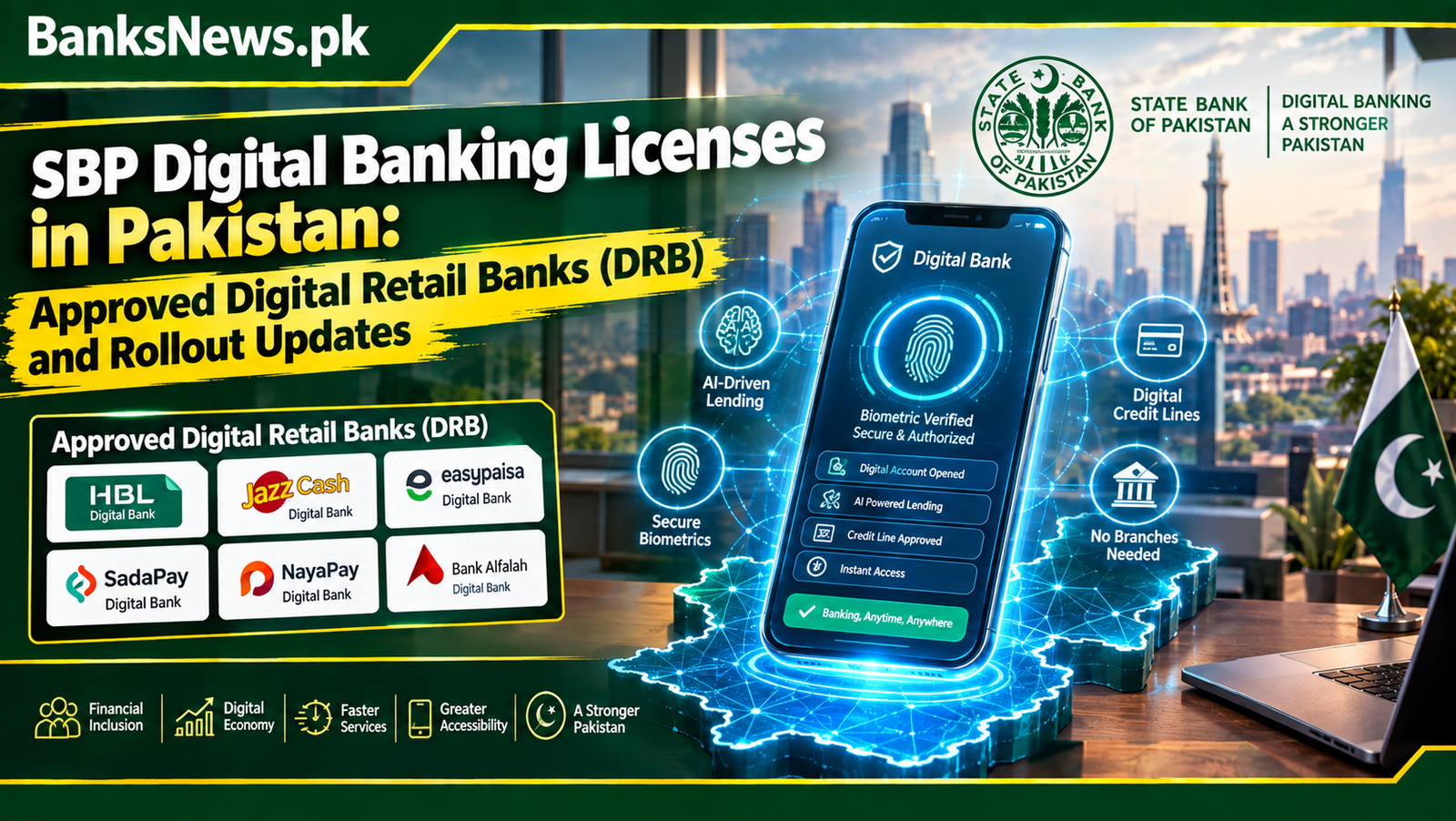
Following an evaluation of roughly twenty domestic and multinational applications, the State Bank awarded In-Principle Approvals (IPAs) and subsequent pilot/commercial licenses to five specialized consortiums:
[Easypaisa Bank Ltd]        ──> Microfinance-to-DRB conversion; backed by Ant Group & Telenor
[Mashreq Bank Pakistan]     ──> UAE multinational giant; leading cross-border & Islamic digital banking
[HugoBank Limited]          ──> Consortium of Getz Bros, Atlas Group, and Singapore's M-DAQ
[KT Bank Pakistan]          ──> Fintech coalition (Kuda Technologies, Fatima Fertilizer, City School)
[Raqami Islamic Digital]    ──> Dedicated Shariah-compliant digital retail bank backed by KSA's RSS & kuwiba
- Easypaisa Bank Limited: Transitioned from Telenor Microfinance Bank into a full-fledged Digital Retail Bank. Backed by Ant Group (Alipay), this license removes historical microfinance deposit caps, enabling larger credit lines and enhanced SME merchant financing.
- Mashreq Bank Pakistan Limited: The digital banking arm of UAE-based Mashreq Group. It entered the market with both conventional and Islamic digital capabilities (Mashreq NEO / NEO BIZ), bringing international infrastructure, advanced SME cash management, and cross-border capabilities.
- HugoBank Limited: Formed through a consortium comprising Singapore’s Hugo (T-Fintech Holdings), Atlas Group, and Getz Bros. It focuses on retail personal financial management (PFM) and wealth-tech micro-investments.
- KT Bank Pakistan Limited: A joint digital venture pairing global digital challenger Kuda Technologies with domestic conglomerates (Fatima Fertilizer and The City School Group), targeting financial inclusion for students, educators, and rural agri-retailers.
- Raqami Islamic Digital Bank Limited: A purpose-built, pure-play Islamic digital retail bank backed by the Kuwait Investment Authority’s subsidiary and Saudi Arabian institutional investors, focusing on Riba-free retail lending and digital Sukuk investments.
Phased Licensing Process: From NOC to Commercial Launch
The SBP enforces a strict, multi-stage compliance roadmap before a digital bank is permitted to accept public funds:
- No Objection Certificate (NOC): Initial clearance allowing the sponsors to incorporate a public limited company under SECP.
- In-Principle Approval (IPA): Grants a 12-month window to build cloud architecture, procure core banking systems (CBS), hire executive leadership, and integrate cybersecurity defenses.
- Restricted License (Pilot Phase): The SBP conducts on-site inspections of core IT and disaster-recovery infrastructure. The bank receives a restricted license to execute pilot transactions with a controlled group of employees and test users for 3 to 9 months.
- Full Commercial License: Following completion of the pilot run and capital verification, the bank receives its full Digital Retail Banking license to onboard the general public.
What Changes for Everyday Pakistani Consumers?
Digital banks differ fundamentally from traditional commercial banks with mobile apps:
- Automated Credit Underwriting (No Salary Slips): Traditional commercial banks decline loans to gig-workers and freelancers lacking formal tax documentation. Digital banks assess creditworthiness via alternative data points: utility payment histories, telecommunication patterns, point-of-sale invoice turnover, and digital wallet cash flows.
- Higher Deposit Yields via Lower Overhead: Traditional commercial banks allocate massive capital to branch rents, armed security, physical utilities, and teller salaries. Digital banks operate lean, cloud-native infrastructures, allowing them to pass operational savings to consumers through higher savings yields and reduced transaction charges.
- Paperless Cross-Border Onboarding: Freelancers, remote software engineers, and small export businesses can complete full business-tier onboarding within minutes, accessing export collection tools, multi-currency IBANs, and automated FBR Section 154A withholding tax reporting.