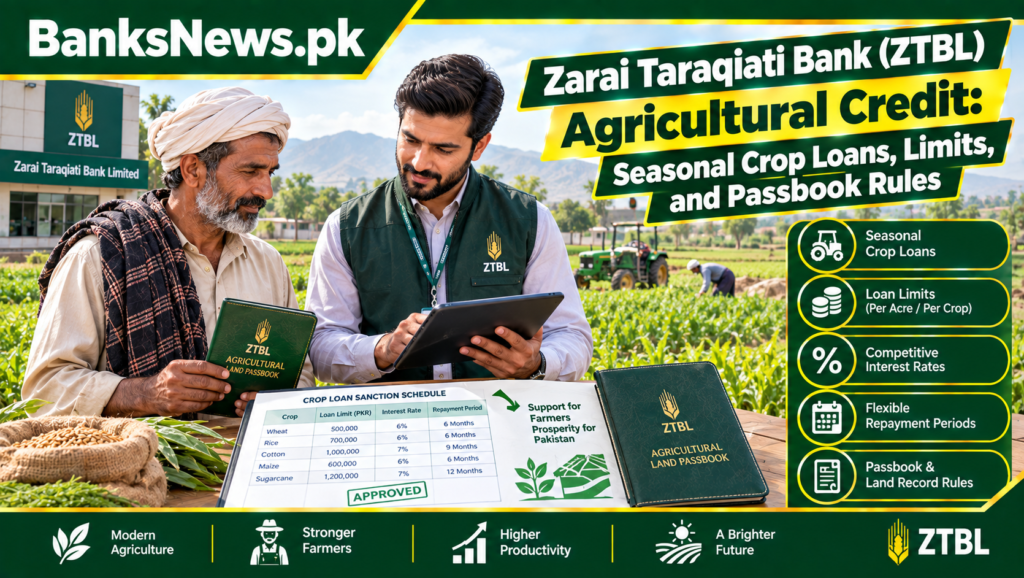
Securing affordable, institutional seasonal credit is vital for Pakistani farmers preparing for Rabi (wheat, gram, oilseeds) and Kharif (cotton, rice, sugarcane, maize) crop cycles. Without bank financing, subsistence and smallholder farmers are often forced to buy fertilizers, diesel, and seeds from informal village commission agents (Arhtis) at mark-ups exceeding 40% to 50% per season.
As the country’s specialized agricultural development bank, Zarai Taraqiati Bank Limited (ZTBL) disburses the largest share of rural farm credit. Through production-oriented programs—predominantly the Kisan Dost Scheme and the Agricultural Passbook Loan System—ZTBL provides working capital tailored directly to seasonal crop harvests.
Below is an itemized breakdown of ZTBL’s seasonal credit limits, land-passbook collateral mechanics, mark-up structures, and the application procedure.
Production Credit vs. Development Credit at ZTBL
ZTBL divides agricultural lending into two distinct operational streams:
| Facility Type | Primary Purpose | Loan Limits | Maximum Tenor |
| Production Loans (Short-Term / Seasonal) | Working capital: Certified seeds, fertilizers, pesticides, fuel, water charges (Abiana), and seasonal farm labor. | Calculated on a per-acre basis up to individual landholding caps. | Up to 12 Months (repayable in a single bullet payment at harvest). |
| Development Loans (Medium / Long-Term) | Capital expenditure: Tube-well boring, solar pump conversion, tractor purchase, farm machinery, and livestock sheds. | Up to asset cost / valuation ceiling. | 3 to 8 Years (repayable in half-yearly installments). |
Per-Acre Seasonal Financing Limits & Mark-up Structure
Production loan limits are determined using the State Bank of Pakistan’s Indicative Credit Limits for Agriculture:
- Per-Acre Allocation: Limits vary by crop type, ranging from PKR 50,000 to PKR 100,000+ per acre for major cash crops (wheat, cotton, sugarcane, rice) and up to PKR 150,000 per acre for high-input orchard and vegetable farming.
- Mark-up / Pricing: Pegged to prevailing concessionary agricultural rates or 1-Year KIBOR + Bank Spread, typically ranging between 14.00% and 18.00% per annum.
- Government Interest-Free Windows: Subsidized government programs (such as targeted federal/provincial flood relief or smallholder schemes) periodically provide 0% markup (Qarz-e-Hasna) for farmers owning up to 12.5 acres, with the interest differential settled directly by the Ministry of National Food Security & Research.
The Agricultural Passbook System: How Security Is Created
The cornerstone of ZTBL seasonal lending is the Agricultural Passbook, governed under the Loans for Agricultural Purposes Act of 1973:
- Passbook Issuance: The local Revenue Officer (Tehsildar / Mukhtiarkar) compiles a computerized or official leather-bound register documenting the farmer’s exact land title, mutation numbers, Mauza/Deh, and cultivated acreage.
- Title Verification & Valuation: ZTBL evaluates the agricultural land value per acre based on official Produce Index Units (PIUs) or prevailing District Collector valuation tables.
- Charge Registration: The Revenue Officer records a formal bank charge directly in the revenue records (Roznamcha Waqiati and mutation register) in favor of ZTBL.
- Permanent Credit Line: Once the passbook charge is registered, the farmer does not need to execute a new land mortgage every season. As long as previous seasonal loans are repaid on time, the passbook remains at the branch, allowing credit limits to roll over annually with minimal paperwork.
Clean / Personal Guarantee Alternatives for Landless Farmers
For tenant farmers (Haris / Muzareen) and rural smallholders without mortgagable land titles, ZTBL offers clean financing windows:
- Two Creditworthy Personal Guarantors: Clean seasonal credit lines up to PKR 200,000 to PKR 500,000 backed by two established local landowners or solvent government/bank account holders.
- Group Lending (Social Collateral): 3 to 5 smallholder farmers form a mutual guarantee group, holding joint and several liability for seasonal credit disbursements.
Eligibility Criteria
To qualify for ZTBL crop financing, applicants must satisfy baseline criteria:
- Identity: Pakistani national holding a valid, active CNIC.
- Farmer Category: Owner-cultivator, tenant cultivator, or registered corporate farming enterprise.
- Age Limits: Minimum 18 years up to 65 years at application (extendable up to 70 years if a joint co-borrower/legal heir is added).
- Clear e-CIB Record: Clean central bank credit bureau status with zero overdue defaults on prior commercial bank, ZTBL, or microfinance agricultural credit lines.
Step-by-Step Application & Harvest Settlement Roadmap
[1. Land Record Update] ──> [2. MCO Field Inspection] ──> [3. Passbook Charge] ──> [4. Input Disbursement] ──> [5. Post-Harvest Payoff]
- Verify Land Records: Ensure your computerized land records (Fard Malkiat) are updated at your local Arazi Record Center (PLRA/e-Khidmat in Punjab, or relevant provincial Land Administration authorities).
- Contact Mobile Credit Officer (MCO): Approach the ZTBL branch serving your designated revenue circle (Union Council). A Mobile Credit Officer visits your farm to verify physical cultivation and acreage boundaries.
- Register Bank Lien: Deposit your official Agricultural Passbook with the revenue authority to register ZTBL’s first charge.
- Disbursement of Funds: The loan is disbursed directly into your ZTBL checking account or via agricultural input payment vouchers for verified seed and fertilizer procurement.
- Post-Harvest Settlement (Bullet Repayment): Repay the principal and accrued markup within 12 months, immediately following the sale of your harvested crop at the local grain market (Mandi). Timely repayment instantly qualifies you for automatic renewal for the subsequent sowing cycle.
Common Pitfalls and Borrowing Advice
- Crop Season Timelines: Apply at least 3 to 4 weeks prior to the seasonal sowing window. Applying mid-season delays fertilizer procurement and reduces crop yields.
- Never Default Past the 12-Month Mark: Missing the one-year maturity deadline converts the loan into a non-performing asset (NPA). This halts your seasonal rollover, damages your e-CIB rating across all Pakistani banks, and initiates land recovery actions through provincial land revenue collectors.