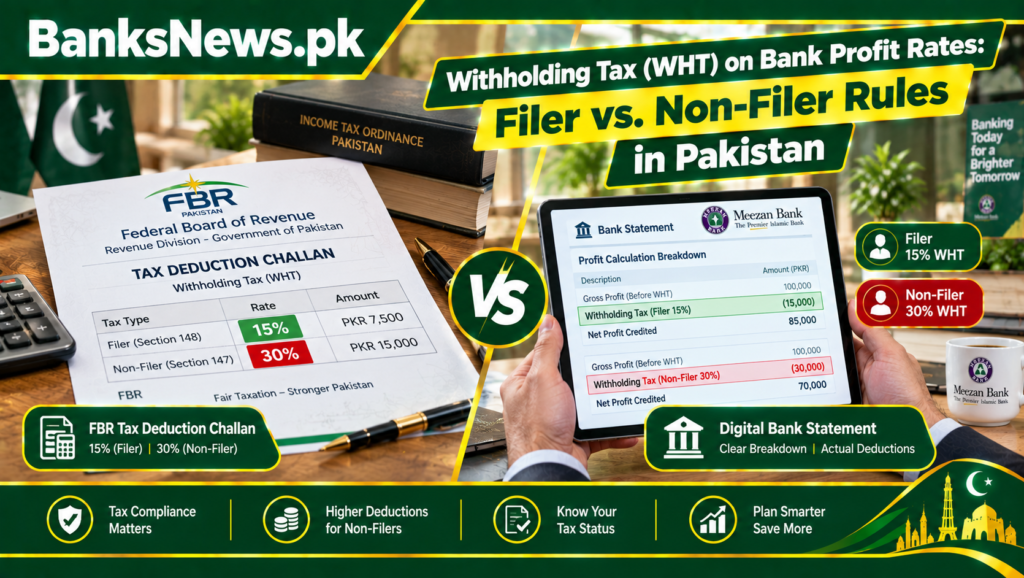
When commercial and Islamic banks announce profit rates on savings accounts and term deposits, those declared percentages represent gross returns. Before that profit reaches your checking or savings account, the bank is legally required to deduct advance income tax at source on behalf of the Federal Board of Revenue (FBR).
Governed primarily under Section 151 (Profit on Debt) of the Income Tax Ordinance, 2001, the rate deducted depends directly on your status on the FBR’s Active Taxpayer List (ATL). For non-filers, punitive tax rates consume nearly a third of total earned profits.
Below is an itemized breakdown of current Withholding Tax (WHT) rates, real-world payout comparisons, ATL verification mechanics, and legal exemptions.
Filer vs. Non-Filer Withholding Tax Rates
The statutory tax deduction on bank profit (Profit on Debt) applies uniformly across both conventional interest and Islamic profit-sharing returns:
| Taxpayer Status on FBR Active Taxpayer List (ATL) | Statutory WHT Rate (Section 151) | Rule Classification |
| Active Taxpayer (Filer) | 15.00% | Standard Final / Minimum Tax rate |
| In-Active / Non-Filer | 30.00% | Punitive rate under Tenth Schedule (100% surcharge) |
| Senior Citizens / Widows (Behbood / Pensioners) | 0.00% (Exempt) | Special exemption under Second Schedule |
Mathematical Impact on Net Returns
To understand how withholding tax affects cash flow, consider an investor holding a PKR 1,000,000 deposit at an indicative gross profit rate of 16.00% per annum (yielding PKR 160,000 in gross annual profit):
| Calculation Parameter | Active Tax Filer (15% WHT) | Non-Filer (30% WHT) |
| Gross Annual Profit | PKR 160,000 | PKR 160,000 |
| Tax Deducted at Source by Bank | PKR 24,000 (15%) | PKR 48,000 (30%) |
| Net Annual Cash Received | PKR 136,000 | PKR 112,000 |
| Effective Net Annual Return | 13.60% | 11.20% |
| Monthly Net Payout | ~PKR 11,333 / month | ~PKR 9,333 / month |
A non-filer sacrifices PKR 24,000 in extra tax on every PKR 1 Million deposited compared to an active filer.
How Banks Determine Your Tax Status (The ATL Rule)
Banks do not rely on verbal declarations or paper NTN certificates when applying tax rates:
- Automated System Query: Core banking engines run automated system queries against the central FBR Active Taxpayer List (ATL) database before calculating monthly or quarterly profit runs.
- The Valuation Cut-Off: If your CNIC appears on the ATL as “Active” on the exact date of profit distribution, the bank deducts 15%. If your status reflects “In-Active” or unlisted on that date, the system automatically applies the 30% deduction.
- Joint Account Rules: In joint accounts, the tax rate is determined based on the primary account holder’s CNIC status, unless specifically segregated under joint tax declarations.
Are Bank Profit Taxes Adjustable or Final?
- For Non-Filers: The 30% tax is a permanent loss. Because non-filers do not submit annual returns, the deducted tax cannot be recovered or credited.
- For Active Filers: Tax deducted on profit on debt under Section 151 functions as a Final Tax for individuals whose only taxable income is profit on debt. However, if you run a business or file full wealth reconciliations, you must declare both the gross profit and the corresponding 15% tax deduction slip in your annual FBR Iris tax return to reconcile your wealth statement.
Statutory Exemptions: Who Pays 0% Tax on Profit?
Under the Second Schedule of the Income Tax Ordinance, 2001, specific categories are legally exempt from withholding tax on profit on debt:
- Behbood Savings Certificates (BSC) & Pensioners’ Benefit Accounts (PBA): Profit earned through these specialized National Savings products is 100% exempt from WHT.
- Roshan Digital Accounts (RDA): Non-Resident Pakistanis investing through RDAs in Naya Pakistan Certificates (NPCs) enjoy full tax exemption or final concessional tax rates covered under specific sovereign guarantees.
- Recognized Provident & Gratuity Funds: Government-recognized retirement and employee provident funds holding approval under Part I of the Sixth Schedule.
Step-by-Step: How to Verify and Fix Your ATL Status
- Verify Your Status Online: Check your status instantly by visiting the official FBR portal (
fbr.gov.pk) under “Active Taxpayer List (Income Tax)” or SMS your 13-digit CNIC to 9966 (format:ATL <space> 13-digit CNIC). - File Pending Tax Returns: If your status is inactive, submit your annual income tax return via the FBR Iris Portal.
- Pay the ATL Surcharge Challan: If filing after the official statutory deadline, pay the nominal ATL Surcharge Challan (PKR 1,000 for individuals via CPR challan code
A01278) to activate your status immediately on the central database. - Obtain Withholding Tax Certificates: At the end of every financial year (post-June 30th), download your official Withholding Tax Deduction Certificate directly from your bank’s mobile app or home branch to attach to your annual tax return.