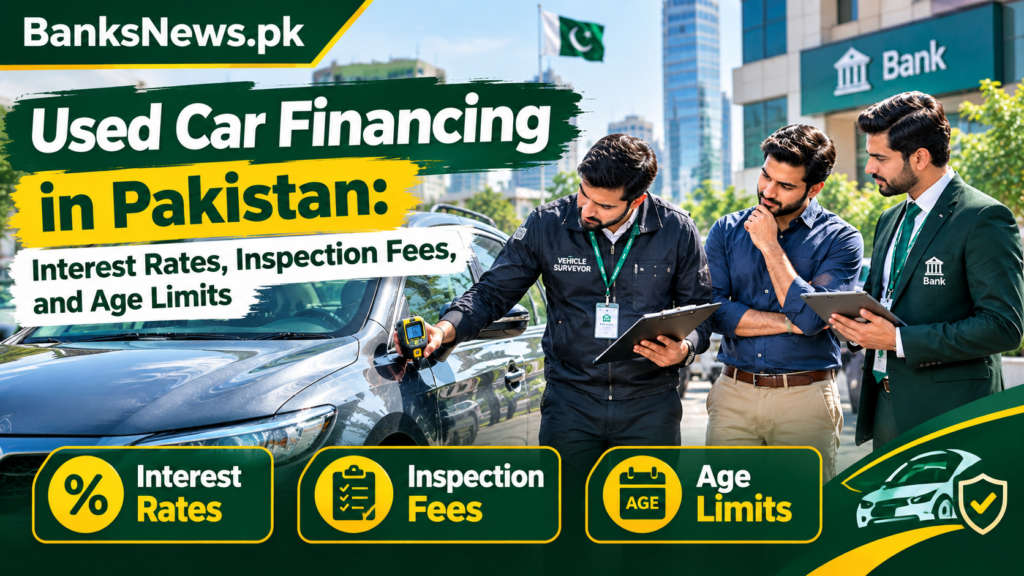
Skyrocketing prices of brand-new vehicles have driven the majority of everyday automobile buyers in Pakistan toward the secondary (used) car market. While commercial and Islamic banks readily finance pre-owned vehicles, approving a secondhand auto loan involves a completely different set of checks compared to financing a factory-fresh car off a showroom floor.
When dealing with pre-owned cars, banks assume asset depreciation and mechanical risks. Consequently, they impose strict vehicle age limits, mandatory physical valuation assessments, and adjusted mark-up margins.
Below is the complete breakdown of used car financing rules, statutory age limits, inspection costs, and documentation requirements across Pakistani banks.
Vehicle Age Limits at Financing and Maturity
The most critical factor determining whether a used car qualifies for bank financing is its manufacturing year. The State Bank of Pakistan (SBP) and individual bank credit policies enforce strict limits on both entry age and loan maturity age:
| Regulatory Parameter | Standard Commercial & Islamic Bank Rule |
| Maximum Age at Application | The vehicle must not be older than 5 to 9 years from its manufacturing year. |
| Maximum Age at Maturity | The vehicle’s age must not exceed 10 to 12 years at the end of the loan tenure. |
| Maximum Allowed Tenure ($\le$ 1000cc) | Up to 5 Years (provided the maturity age cap is not breached). |
| Maximum Allowed Tenure ($>$ 1000cc) | Capped strictly at 3 Years under SBP Consumer Regulations. |
| Eligible Vehicle Origins | Locally assembled vehicles; strictly no gray-market undocumented imports. |
Example: If a bank has a 12-year maturity ceiling and you want to finance an 8-year-old 1300cc car, the bank can only offer a tenure of up to 3 years (8 + 3 = 11 years), satisfying both the tenure and maturity caps.
Valuation Reports and Inspection Fees
Unlike new vehicles with standard manufacturer invoices, a used car’s financing value is determined exclusively through an independent physical appraisal.
- Panel Valuation Agencies: Banks assign certified third-party inspection firms (e.g., Pak Inspection Company, SGS, Munawar Associates, or PakWheels Inspection) to audit the car.
- Inspection Fee: Ranging from PKR 6,000 to PKR 12,000 + FED (payable by the buyer regardless of whether the loan is ultimately approved).
- Loan Calculation Basis: The bank calculates your equity and down payment against the appraised market value or the agreed purchase price, whichever is lower. If a seller asks PKR 3,000,000 but the valuation report values the car at PKR 2,600,000, the bank will only calculate your loan against the PKR 2,600,000 benchmark.
Mark-up Rates and Down Payment Slabs
Used car loans carry slightly higher margins compared to promotional new-car corporate tie-ups:
- Interest / Profit Rates: Typically priced at 1-Year KIBOR + 3.00% to 5.50% Bank Spread (variable rate).
- Minimum Down Payment:
- Minimum 30% for engines up to 1000cc.
- 40% to 50% for engine displacements exceeding 1000cc (SUVs, crossovers, and executive sedans).
- Takaful / Insurance Premium: Averages 1.8% to 2.5% per annum of the appraised value, which includes mandatory tracker installation charges.
Mandatory Document Verification Checklist
Used car processing requires thorough legal title scrutiny to protect against stolen vehicles, duplicate registrations, and unpaid municipal taxes:
- Original Registration Book / Smart Card: Must be physically produced for legal verification (duplicate books face heavy scrutiny and frequent rejection).
- Complete Running / Return File: Original sales invoice, sales certificate from the manufacturer, and all intermediate transfer deeds.
- Tax Token Clearance: Up-to-date motor vehicle annual token tax receipts paid through the provincial excise system.
- Biometric Transfer Slip: Verified seller biometric verification record confirming willingness to transfer ownership into the bank’s or borrower’s name with hypothecation lien.
Step-by-Step Purchase and Disbursement Workflow
- Find the Car & Settle Seller Terms: Agree on a tentative price with the private seller or used-car dealership, subject to bank clearance.
- Apply at the Bank Branch: Submit your application along with income proofs (salary slips or business bank statements) and copies of the vehicle’s registration papers.
- Appraisal & Mechanical Audit: The bank dispatches an inspector to evaluate the car’s body condition, frame integrity, odometer reading, and engine health.
- Legal & Excise Clearance: The bank’s legal team verifies excise records to ensure the chassis number is not blacklisted by the police or Anti-Car Lifting Cell (ACLC).
- Pay Order Issuance: The bank issues a Pay Order directly in the seller’s name once biometric transfer documents and hypothecation liens are executed at the regional Excise & Taxation office.
Common Pitfalls to Avoid
- Major Accidental Damage: If the third-party survey identifies structural pillar, apron, or chassis damage, the bank will immediately decline financing, and your inspection fee will be forfeit.
- Altered Engine Blocks: Vehicles with unendorsed engine block replacements that do not match the official excise book records are declined on the spot.
- Token Tax Arrears: Always ask the seller for digital proof of tax payments; unpaid excise duties must be cleared before the bank releases payment.