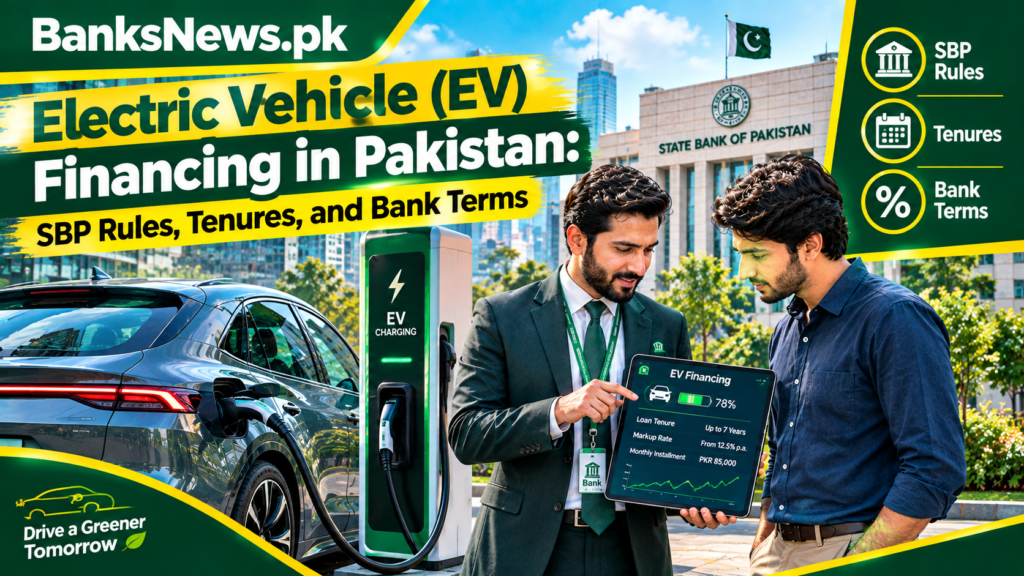
As fuel prices remain volatile and international EV brands establish local assembly and import networks, electric mobility is gaining traction across Pakistan. However, financing an Electric Vehicle (EV) or New Energy Vehicle (NEV) does not operate under the identical regulatory conditions as traditional internal combustion engine (petrol and diesel) cars.
To incentivize green transportation while controlling import-driven trade deficits, the State Bank of Pakistan (SBP) has modified auto financing prudential regulations, creating specific frameworks for electric passenger cars, e-bikes, and commercial clean mobility.
Below is the complete, practical guide to EV auto financing regulations, down payment structures, maximum loan limits, and leading bank policies.
SBP Prudential Regulations: Conventional Cars vs. Electric Vehicles
The State Bank of Pakistan’s Consumer Financing Regulations enforce distinct rules between fossil-fuel vehicles and electric vehicles:
| Regulatory Metric | Conventional Combustion Cars (> 1000cc) | Electric Vehicles (EVs / NEVs) |
| Maximum Financing Tenure | Up to 3 Years (Strict SBP restriction) | Up to 5 to 7 Years (under green policy tiers) |
| Minimum Down Payment | Minimum 30% to 50% | Standard 15% to 30% (locally assembled models) |
| Maximum Financing Limit | Capped at PKR 3,000,000 per borrower across all banks | Relaxed caps up to PKR 5,000,000 to PKR 10,000,000 for verified green units |
| Debt Burden Ratio (DBR) | Total monthly debt EMIs capped at 40% of net monthly income | 40% standard DBR applies |
(Note: SBP’s relaxed loan limits apply predominantly to locally manufactured or assembled electric models and authorized institutional imports, rather than gray-market secondhand CBU luxury imports).
Commercial Bank EV Portfolios
Several leading financial institutions offer structured auto loan products tailored to electric vehicles:
- Bank Alfalah Green Auto Loan: Offers financing for both hybrid electric vehicles (HEVs) and battery electric vehicles (BEVs). Terms include discounted tracker subscriptions, flexible tenures up to 5 years, and variable pricing linked to 1-Year KIBOR plus a subsidized bank spread.
- Meezan Bank Car Ijarah (EV Variant): Operates under a Shariah-compliant lease structure. The contract features specialized Takaful terms addressing EV battery pack replacements and charging station installations.
- The Bank of Punjab (BOP) Green Drive: Provides commercial and private electric transport financing, prioritizing local fleet operators and small businesses adopting commercial electric delivery vans.
Cost Sharing Scheme for Electric Two-Wheelers & Three-Wheelers
For students, gig workers, and daily commuters, the SBP alongside the Ministry of Industries and Production rolled out a targeted concessional framework for E-Bikes and E-Rickshaws:
- End-User Profit Rate: 0% (Full mark-up subsidy paid directly by the Federal Government).
- Capital Subsidy: Up to PKR 50,000 for e-bikes and up to PKR 200,000 for commercial e-rickshaws.
- Financing Tenure: Up to 2 years for e-bikes; up to 3 years for e-rickshaws.
- Down Payment: 20% minimum equity contribution.
- Eligible Lending Banks: UBL Ameen, National Bank of Pakistan (NBP), Bank of Punjab (BOP), and designated microfinance entities.
Key Financial Traps to Watch Out For
Before signing an EV financing agreement, keep these operational factors in mind:
- Battery Replacement & Takaful Clauses: An EV battery pack accounts for roughly 40% to 50% of the car’s replacement value. Confirm whether the bank’s panel insurance or Takaful policy covers complete battery replacement in accidents, power surges, or water immersion, rather than applying standard depreciation deductions.
- Depreciation on High-Value Imports: Completely Built-Up (CBU) electric cars often face steep resale depreciation when newer battery technologies enter the market. Opting for shorter 3-to-4-year tenures helps prevent owing more on your loan balance than the car’s secondary market value.
- Home Wallbox Charger Inclusion: Some banks allow bundling the purchase and certified electrical installation of a Level 2 7kW–22kW home wall-box charger directly into the principal loan package. Request this inclusion upfront to avoid heavy out-of-pocket costs post-delivery.