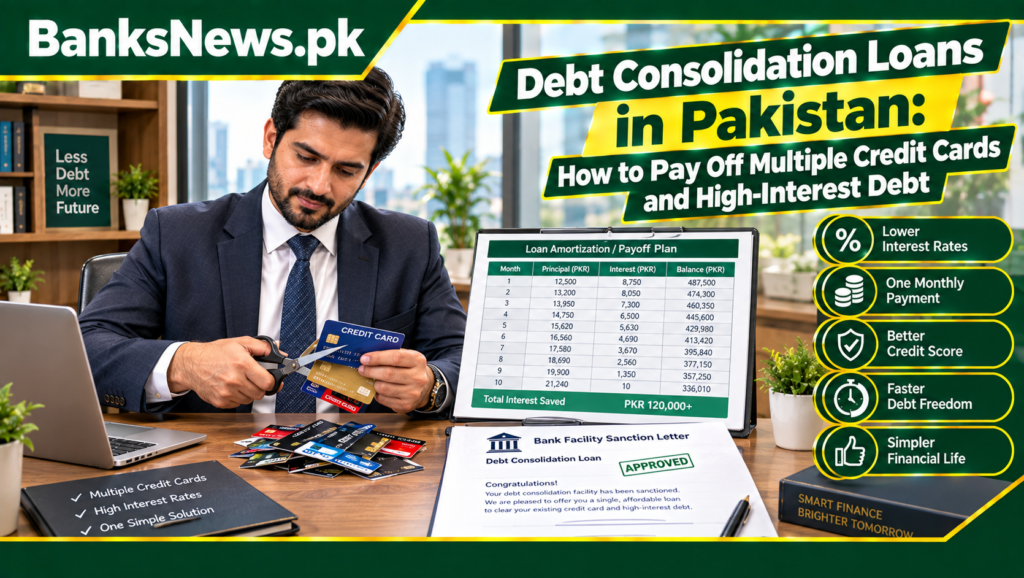
Revolving credit card debt in Pakistan is among the most expensive forms of consumer borrowing. With annual percentage rates (APR) typically ranging from 36% to over 45% per annum (plus compounding monthly service charges and late payment penalties), paying only the “minimum 5%” each month keeps borrowers trapped in compounding debt for years.
When you juggle balances across multiple credit cards and micro-loans, a Debt Consolidation Loan or a Balance Transfer Facility (BTF) allows you to combine those fragmented debts into a single, structured installment loan at a lower mark-up rate.
Below is an itemized guide explaining how debt consolidation works in Pakistan, the difference between BTFs and personal loans, State Bank of Pakistan (SBP) debt limits, and a step-by-step payoff roadmap.
Credit Cards vs. Consolidated Term Loans: The Cost Difference
The primary financial justification for consolidating debt is the dramatic difference in annual borrowing costs:
| Dimension | Revolving Credit Card Balances | Debt Consolidation / Term Loan |
| Annualized Markup / APR | 36.00% to 45.00%+ per annum | ~24.00% to 32.00% per annum (or promotional BTF flat rates) |
| Interest Calculation | Compounding monthly on average daily balance | Reducing balance installment or fixed flat promotional rate |
| Repayment Structure | Revolving minimum due (often extends 10+ years) | Fixed Equated Monthly Installment (EMI) over 12 to 48 months |
| Credit Score Impact | High credit utilization hurts e-CIB rating | Clears revolving utilization; reports as an amortizing loan |
| Payment Management | Multiple statements, due dates, and late fee risks | Single monthly installment on a fixed date |
The Two Primary Consolidation Mechanisms in Pakistan
Borrowers can structure consolidation through two primary banking channels:
1. Credit Card Balance Transfer Facility (BTF)
Several major commercial banks (e.g., MCB Bank, Standard Chartered, Bank Alfalah, and Faysal Bank) offer dedicated Balance Transfer Facilities:
- How It Operates: Bank B pays off your outstanding balance on Bank A’s credit card directly via Pay Order or interbank transfer.
- Promotional Mark-up Windows: Many banks offer introductory promotional rates (e.g., flat mark-up rates as low as 1.5% to 2.0% per month) for fixed tenures of 12, 18, or 24 months.
- Processing Fee: Banks typically levy a one-time BTF processing charge of PKR 1,500 to PKR 3,000 + FED (or 1.5% to 2.0% of the transferred balance).
2. Unsecured Personal Clean Loan Consolidation
If your aggregate debt spans multiple credit cards alongside running salary advances, you can apply for an unsecured personal loan (such as an HBL Personal Loan or MCB Personal Loan) up to PKR 2 to 3 Million:
- Direct Payoff: Use the disbursed loan proceeds to settle and immediately cancel your external credit cards in full.
- Fixed Amortization: You lock in a fixed 3-to-4-year repayment tenure, guaranteeing that every rupee paid reduces the principal balance.
SBP Regulations: The Debt Burden Ratio (DBR) Hurdle
Under State Bank of Pakistan (SBP) Prudential Regulations for Consumer Financing (Regulation R-3), banks cannot extend unlimited credit to help you pay off existing debt:
- The 40% to 50% DBR Ceiling: The total sum of all your monthly debt commitments (including the applied consolidation installment and minimum payments on active cards) cannot exceed 40% to 50% of your verifiable net monthly disposable income.
- Clean e-CIB Mandate: You must apply for consolidation before entering default. If your SBP e-CIB report shows overdue accounts flagged with “30+ Days Overdue” or “Write-Off / Settlement” status, commercial banks will decline the application. Debt consolidation requires an active, performing credit profile.
Step-by-Step Debt Consolidation Roadmap
[Step 1: Audit Balances] ──> [Step 2: Compare BTF vs Loan] ──> [Step 3: Direct Settlement] ──> [Step 4: Cancel Cards & Obtain NOC]
- Audit Total Outstanding Dues: Gather the latest billing statements for every active credit card and personal loan. Note down the exact outstanding principal balance, APR, and monthly minimum payments.
- Apply for a Single Facility: Approach the bank where your salary is credited, or an institution offering a competitive BTF rate. Request a consolidation limit that matches your total outstanding revolving debt.
- Execute Direct Settlements: Instruct the lending bank to issue Pay Orders drawn directly in the names of your creditor card departments (e.g., “Bank Alfalah Credit Card Account Number XXXXXXXX”), ensuring the funds clear existing card balances rather than being diverted elsewhere.
- Mandatory Step — Cancel the Old Cards & Obtain NOCs: Once the card balances show zero, call each bank’s helpline to formally close the accounts. Request an official No Objection Certificate (NOC) / Settlement Certificate to confirm the credit limit is cancelled on the central bank’s e-CIB registry. Leaving cards open with zero balances still consumes your borrowing capacity under SBP DBR calculations.
Traps to Avoid During Debt Consolidation
- The Double-Debt Trap: The biggest risk in debt consolidation is clearing credit cards and then continuing to swipe them for everyday lifestyle purchases. Always cancel consolidated cards to prevent doubling your overall debt burden.
- Ignoring Pre-Settlement Charges: When transferring a personal loan balance to another bank, verify if your current bank charges an early payoff fee (often 3% to 7% of outstanding principal), and factor that into your net savings calculations.