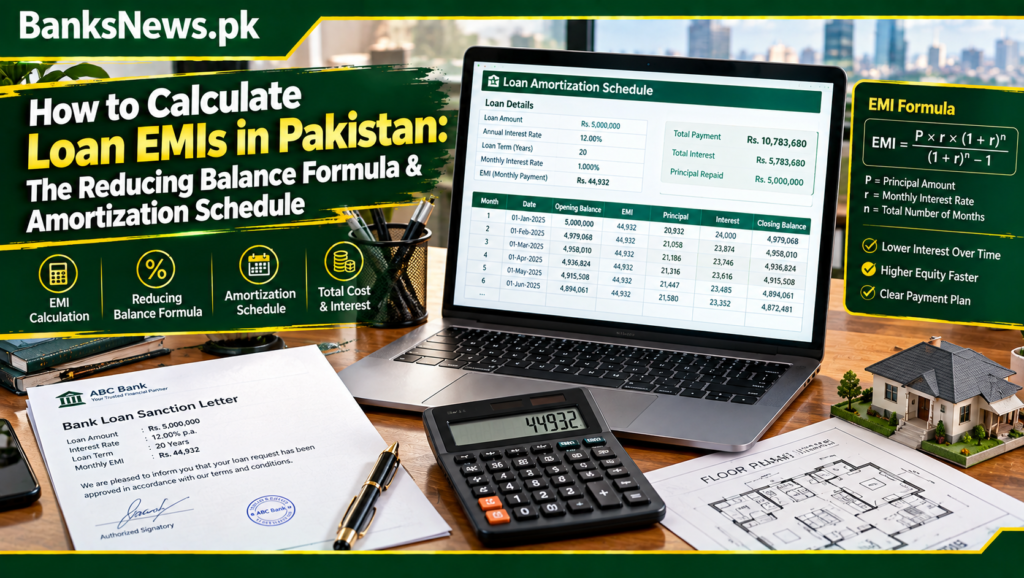
When securing an auto loan, personal loan, or home mortgage (Maskan / Apna Ghar) from a Pakistani commercial or Islamic bank, borrowers frequently focus only on the headline markup figure (e.g., “1-Year KIBOR + 3.5%”). However, the factor determining your monthly cash outflow is the Equated Monthly Installment (EMI), structured across a formal Amortization Schedule.
In Pakistan, banks calculate installments using the reducing balance method. Unlike simple flat-rate loans where interest is charged on the original principal for the entire loan life, a reducing balance amortization schedule recalculates markup each month solely on the remaining unpaid principal.
Below is an itemized guide explaining the mathematical EMI formula, the flat-versus-reducing cost disparity, KIBOR floating revisions, and a sample amortization table.
The Standard Loan Amortization Formula
Commercial banks (such as HBL, Bank Alfalah, MCB, and Meezan Bank under Diminishing Musharakah) determine your fixed monthly payment using the standard reducing-balance amortization equation:
$$\text{EMI} = P \times \frac{r(1+r)^n}{(1+r)^n – 1}$$
- $P$ (Principal): The total net loan amount disbursed by the bank.
- $r$ (Periodic Monthly Interest Rate): The annualized percentage rate divided by 12 months and divided by 100 ($r = \frac{\text{Annual Rate}}{12 \times 100}$).
- $n$ (Total Number of Monthly Installments): The loan duration in years multiplied by 12 ($n = \text{Tenure in Years} \times 12$).
Worked Example: PKR 1,000,000 Loan Over 3 Years
Assume you borrow PKR 1,000,000 for a consumer car or personal facility at an annual markup rate of 18.00% over a 3-year (36-month) tenure:
- $P = 1,000,000$
- $r = \frac{18}{12 \times 100} = 0.015$ (1.50% per month)
- $n = 3 \times 12 = 36 \text{ months}$
$$\text{EMI} = 1,000,000 \times \frac{0.015(1 + 0.015)^{36}}{(1 + 0.015)^{36} – 1} \approx \mathbf{\text{PKR 36,152 per month}}$$
Over 36 months, total payments equal PKR 1,301,472, meaning the total markup paid across 3 years is PKR 301,472.
How Amortization Works: Principal vs. Markup Split
An amortization schedule breaks down every monthly installment into two components:
- Markup (Profit) Portion: $\text{Beginning Monthly Balance} \times r$
- Principal Repayment Portion: $\text{Fixed Monthly EMI} – \text{Markup Portion}$
In early months, the principal balance is high, so the majority of your EMI covers interest. As you make payments, the remaining balance declines, causing the monthly markup portion to shrink and the principal repayment to accelerate.
| Month | Opening Balance (PKR) | Fixed EMI (PKR) | Markup Portion (1.5%) (PKR) | Principal Repayment (PKR) | Closing Balance (PKR) |
| Month 1 | 1,000,000 | 36,152 | 15,000 | 21,152 | 978,848 |
| Month 2 | 978,848 | 36,152 | 14,683 | 21,469 | 957,379 |
| Month 3 | 957,379 | 36,152 | 14,361 | 21,791 | 935,588 |
| … | … | … | … | … | … |
| Month 35 | 70,724 | 36,152 | 1,061 | 35,091 | 35,633 |
| Month 36 | 35,633 | 36,152 | 534 | 35,618 | 0 |
Reducing Balance vs. Flat Rate: The Cost Difference
Automobile dealerships and non-bank leasing agents sometimes market loans using a “Flat Rate” (e.g., “Only 10% Flat Rate!”). A flat rate charges mark-up on the full original loan amount for the entire tenure, ignoring your monthly principal repayments.
- On a 5-year loan, a 10% Flat Rate is roughly equivalent to an 18% to 19% Reducing Balance Rate.
- Always ask your bank for the Effective Annual Rate (APR) / Reducing Balance Rate rather than accepting flat-rate quotes.
The KIBOR Factor: Why EMIs Change on Floating Loans
Most long-term consumer loans in Pakistan (such as car financing or home mortgages) are variable rate facilities pegged to 6-Month or 1-Year KIBOR:
- The Rate Structure: $\text{Applicable Rate} = \text{KIBOR} + \text{Bank Spread}$ (e.g., $11.50\% + 3.50\% = 15.00\%$).
- Anniversary Revisions: On your loan’s annual or semi-annual reset date, the bank checks the current KIBOR benchmark. If KIBOR has risen or fallen, the bank re-runs the amortization formula on your remaining principal balance, recalculating your fixed monthly EMI upward or downward for the upcoming cycle.