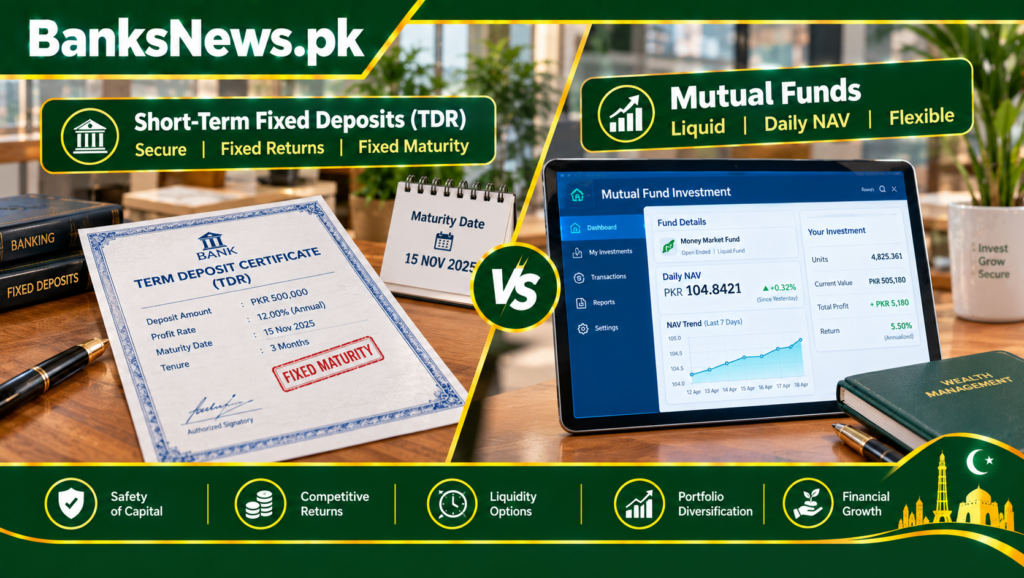
When parking temporary liquidity—such as property sale proceeds awaiting reinvestment, annual business tax reserves, or emergency household buffers—leaving funds in a standard checking account loses value to domestic inflation.
In Pakistan, investors generally choose between two short-term vehicles: commercial bank Term Deposit Receipts (TDRs) or open-ended Money Market / Cash Mutual Funds managed by Asset Management Companies (AMCs).
While both options provide capital preservation with low volatility, they differ substantially in liquidity restrictions, daily compounding, tax efficiency, and early withdrawal penalties.
Below is a direct comparison to help you select the right vehicle for your cash parking horizon.
Side-by-Side Comparison
| Feature | Bank Term Deposit Receipts (TDR) | Money Market / Income Mutual Funds |
| Issuer / Counterparty | Commercial or Islamic Banks | Asset Management Companies (AMCs) |
| Regulatory Body | State Bank of Pakistan (SBP) | Securities & Exchange Commission of Pakistan (SECP) |
| Typical Lock-in Tenors | Fixed: 1, 3, 6, or 12 Months | Zero Lock-in (Redeemable anytime) |
| Liquidity & Access | Early encashment breaks the certificate and forfeits profit | T+1 to T+2 Business Days (Instant redemption up to PKR 100k) |
| Compounding Frequency | Simple return paid at maturity or monthly flat payout | Daily NAV accumulation (Compounding return) |
| Withholding Tax (Filer) | 15.00% on profit on debt (Section 151) | 15.00% on capital gains / dividend income |
| Withholding Tax (Non-Filer) | 30.00% on profit on debt | 30.00% to 45.00% (punitive non-filer brackets) |
| Credit / Default Risk | Backed by bank balance sheet (commercial risk) | Backed by diversified short-term T-Bills, GoP Ijara Sukuk & bank placements |
1. Bank Term Deposit Receipts (TDRs): Fixed Certainty
A TDR is a formal promissory contract with a commercial bank where you deposit capital for an agreed period (e.g., 3 months or 1 year) at a pre-agreed profit rate:
- Fixed Nominal Rate: Once booked, your rate is locked. If the central bank cuts its policy rate during your term, your agreed return remains protected through maturity.
- The Premature Penalty Trap: If you encounter an emergency and need your money 20 days before a 6-month certificate matures, the bank applies a premature encashment penalty. Most banks recalculate the entire elapsed period at the lowest baseline PLS savings rate (often docking 3% to 6% off the yield) or forfeit accrued profit entirely.
- No Daily Compounding: TDRs pay profit at maturity or in periodic monthly disbursements; they do not automatically compound into the principal daily.
2. Money Market Mutual Funds: Maximum Liquidity & Daily Accrual
Money market mutual funds (such as Meezan Rozana Amdani Fund, UBL Liquidity Plus Fund, MCB Cash Management Optimizer, or NBP Money Market Fund) pool investor capital exclusively into ultra-short-term, low-risk debt instruments:
- Underlying Holdings: Under SECP regulations, money market funds cannot invest in equities or volatile long-term bonds. They hold Government Treasury Bills (T-Bills), short-term sovereign Sukuk, and high-rated bank deposits, carrying minimal credit or interest rate risk.
- Daily Dividend & NAV Compounding: Many funds calculate and declare dividends every single day. That profit is immediately reinvested into additional fund units, creating a continuous compounding effect.
- Unrestricted Liquidity: You can redeem funds on any working day without losing accrued returns:
- Standard Redemption: Cash credits directly into your commercial bank account via 1Link within 24 to 48 hours (T+1).
- Instant Transfer (E-Redemption): Most top-tier AMCs offer instant mobile redemptions (up to PKR 100,000 to PKR 250,000 daily) transferred to your bank account or 1Link debit card within 60 seconds.
Real-World Case Study: 60-Day Cash Parking
Consider an investor holding PKR 5,000,000 for roughly 50 to 60 days while awaiting a commercial property closing:
- Scenario A (3-Month TDR): If the money is locked in a 3-month TDR and needed on day 50, the investor must break the certificate. The bank retroactively slashes the profit to the basic savings rate, forfeiting a significant portion of the expected return.
- Scenario B (Money Market Mutual Fund): The investor parks PKR 5,000,000 into a daily-dividend money market fund. For exactly 50 days, the investment accrues daily returns. On day 50, the investor submits a redemption request, collecting the principal alongside 50 full days of accrued profit, with zero exit penalties.
Decision Framework: Where Should You Park Your Cash?
- Choose a Bank TDR if:You have an exact, immovable deadline (e.g., your child’s overseas university tuition is due in precisely 6 months), you expect the State Bank to slash interest rates soon, and you want to lock in a guaranteed fixed return.
- Choose a Money Market Mutual Fund if:Your cash deployment timeline is uncertain (e.g., 2 weeks to 3 months), you want to avoid premature encashment penalties, and you value the flexibility of instant mobile app redemptions with daily compounding returns.